Category: News

  • Another Attempt at a Hemp Beverage Carve Out

    Another Attempt at a Hemp Beverage Carve Out

    Today, Rep. Beth Van Duyne (R-TX) is circulating a draft of The Hemp-Derived Beverage Regulatory Clarity Act. Unlike others bills that focused on the broad Hemp THC category and including everything from edibles to smokeables, this attempt focus specifically on beverages. It would legalize Hemp THC beverages federally, capping the dose at 5mg and creating a tax of $0.10 per milligram. It would be age-gated at 21+ and place oversights with the Treasury Department’s Tax and Trade Bureau (TTB also manages alcohol labeling) in consultation with the Department of Health and Human Services.

    Focusing just on beverages is a decent strategy, but this has one glaring gap. TESTING! No testing requirements. It does say that the TTB could set regulations for testing, packaging, labeling and serving and container sizes. But seeing that it takes several months to get a beer label approved, I’m not sure this is the best idea. Even if it goes through, which is unlikely, it could take months or years for regulations to be created.

  • The Evolution of Hemp THC Beverages: Moving Beyond DTC

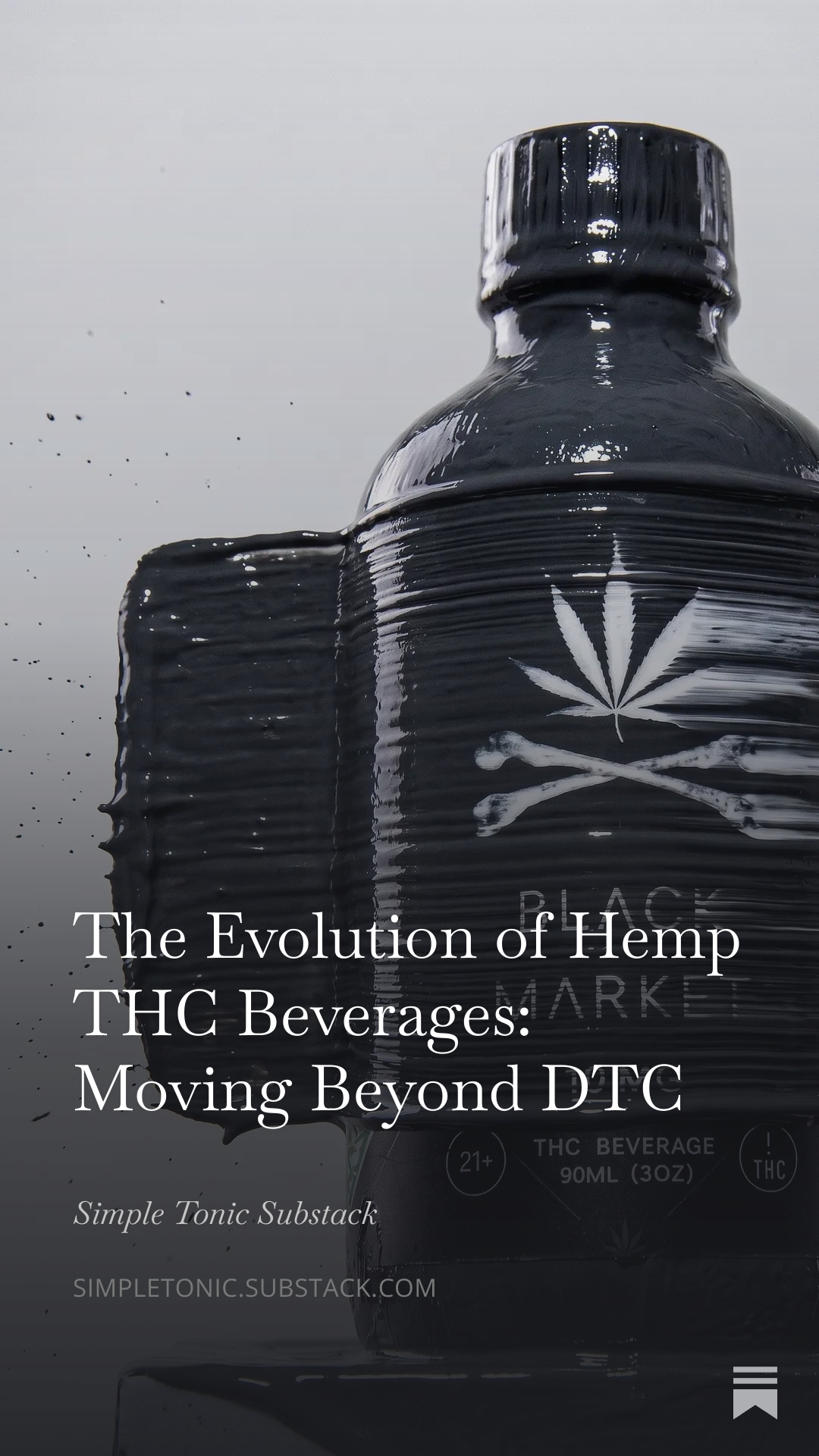
    The Evolution of Hemp THC Beverages: Moving Beyond DTC

    Lines are blurred with a major shift in how hemp-derived THC beverages go to market. The days of relying entirely on a direct-to-consumer (DTC) playbook are ending, and the latest news from Hightails LLC perfectly illustrates where the industry is headed next.

    Hightails—the parent company behind Black Market and High Standard Hemp-Derived THC Beverages—has just inked a strategic partnership with Spirited Insiders LLC.

    For those unfamiliar, Spirited Insiders isn’t a cannabis company; they are a brand services agency in the traditional beverage alcohol space. Run by industry veterans, they work with established brands like Brooklyn Gin, Papa’s Pilar Rum, and Waterford Irish Whisky.

    Why This Matters

    This partnership is a prime example of a growing trend: regardless of the doom of the impending federal hemp ban, hemp THC beverage brands are stepping out of the DTC echo chamber and leaning into the traditional “blocking and tackling” required to win the door-to-cooler retail game. To get into big box retailers, grocery chains, and independent liquor stores, hemp brands are realizing they need serious bev-alc expertise.

    • Deep route-to-market experience
    • Established distributor relationships
    • Proven field execution

    The Distributor Reality Check

    There is a common misconception in the emerging hemp beverage space that landing a distributor equals instant access to thousands of accounts. The reality is much more complicated.

    A distributor contract is just a hunting license. Actually getting your cans into a cooler requires navigating a complex web of traditional retail challenges:

    • Pricing & Programming: Structuring margins that make sense for the supplier, the distributor, and the retailer.
    • Incentives: Finding creative ways to motivate and capture the attention of a busy distributor salesforce.
    • The Gatekeepers: The distributor sales rep is the ultimate gateway to the retail account.

    You can show a retailer all the localized social media followers and engagement metrics in the world, but if you don’t have the internal distributor mechanics dialed in, you won’t get the shelf space.

    The Bottom Line

    Cracking the traditional retail market requires an entirely different set of muscles than running targeted Instagram ads. As the fight for retail cooler space heats up, it is becoming increasingly clear that hemp brands aren’t going to go it alone—they are bringing in the bev-alc veterans to help them navigate the trenches.

  • The Barr Act’s Two-Tier Trouble: Why States Might Change Any Federal Hemp THC Rules

    The Barr Act’s Two-Tier Trouble: Why States Might Change Any Federal Hemp THC Rules

    Rep. Andy Barr (R-KY) recently introduced a bill designed to amend the Federal Food, Drug, and Cosmetic Act to regulate cannabinoid hemp products. For those tracking the beverage space, this legislation proposes a distinct regulatory framework specifically for Hemp THC beverages by establishing a new two-tier system.

    Under this proposed framework, producers have the flexibility to manufacture and distribute these hemp beverages anywhere across the country. However, the producer cannot sell the product directly to the consumer. The second tier of this system relies entirely on retailers.

    Practically speaking, this will likely create a bifurcated distribution model: smaller, regional distributors will handle sales directly to local retail shops, while producers will distribute directly to large-scale retailers. In many cases, this involves shipping the product directly to a few central warehousing locations owned by those large retailers.

    The Local Impact

    Look at a heavily regulated state like Massachusetts for example. The Barr Act creates a completely new system that the state may or may not embrace. To understand why this is so disruptive, here is what the proposed hemp framework looks like compared to existing local models:

    Cannabis (Vertically Integrated): Within the borders of Massachusetts, the cannabis industry is vertically integrated. A single company can own a grower’s license, a producer/distribution license, and a retail license. They can sell their products through the system directly to the retailer.

    Alcohol (The Three-Tier System): Traditional alcohol operates on a three-tier model, where out-of-state producers sell to in-state distributors. Tax is collected as an excise tax at the distributor level. These distributors cannot own a retail license (Note: There is an exemption for in-state farmers and brewers, allowing smaller brewers and distillers to sell directly to retail and to consumers in their tasting rooms).

    Hemp (Under the Barr Act): This brings us back to the proposed two-tier system. Under this act, a company could theoretically produce a beverage in New Jersey and ship it directly to a Target in Massachusetts.

    Massachusetts currently bans hemp cannabinoids in food and beverages. Even if the Barr Act successfully passes at the federal level, I do not see this structure in place at the local level. A recent attempt at proposed legislation (S.222) in Massachusetts would have created a strict three tier system for hemp products. Instead of passing S.222, the final legislation adopted a more cautious approach. The new law mandates that the newly restructured Cannabis Control Commission (CCC) must first comprehensively study the market and impacts of intoxicating hemp products.

    The Barr Act looks to undermine many local legislative actions that have evolved over years.

  • Why Some States Ban Hemp THC Beverages: Same Molecule, Different Story

    Why Some States Ban Hemp THC Beverages: Same Molecule, Different Story

    Crack open a THC seltzer at a summer cookout in some states and you may see two cans on the same table—one cannabis-derived, one hemp-derived—claiming the same milligrams and selling the same buzz. The molecule inside is, in fact, the same. Ask anyone who’s spent a shift inside an extraction facility, though, and they’ll tell you the road that molecule took to reach the can is wildly different. And that story matters.

    The Plant Is the Same. The Legal Definition Isn’t

    Hemp and cannabis are the same plant. Cannabis sativa L. Congress just drew a line down the middle of it. The 2018 Farm Bill made it official: at 0.3% delta-9 THC or less by dry weight, you’re holding federally legal hemp. A hair above that, and the same plant is federally controlled cannabis. Same genome, different paperwork. The catch—and it’s a big one—is that at 0.3% THC, you need a serious pile of plant to make anything anyone wants to drink.

    Cannabis-Derived THC: Fully Tested in Massachusetts

    Start with high-THC cannabis flower—18 to 30% THC is normal—and extraction is the easy part of the day. The compound you want is sitting right there in the trichomes, waiting. Pick your tool:

    • Supercritical CO₂ extraction uses pressurized carbon dioxide as a solvent

    • Hydrocarbon extraction (butane or propane) is fast and preserves a full terpene profile

    • Ethanol extraction is efficient at scale and works well for tinctures and beverages

    • Solventless methods like ice water hash and rosin pressing use only physical agitation, heat, and pressure

    What you get back is an extract whose cannabinoid and terpene profile mirrors the plant it came out of. Minimal chemistry, maximum fidelity. Stack Massachusetts’s seed-to-sale tracking and mandatory state testing on top of that, and the consumer cracking the can has a defensible reason to trust the milligrams on the label—and to assume nothing strange is hiding in the liquid.

    Hemp-Derived THC, Route #1: Squeeze It Out of a Whole Lot of Plant

    You can pull native delta-9 THC straight out of hemp biomass. People do it, and you’ll often see the result labeled “naturally derived” or “full-spectrum hemp.” The math just doesn’t work. At roughly 0.3% THC against cannabis’s 25%, you’re feeding 80 to 100 times more plant through the extractor for every gram of THC at the end. More biomass means more solvent. More solvent means more places for things to go sideways—and more residue to chase out before whatever’s left is fit to sell.

    Then there’s the co-extraction problem. Hemp typically carries 10 to 15% CBD—30 to 50 times the THC riding alongside it. What comes off the column is overwhelmingly CBD with a whisper of THC dissolved into it. Turning that into a salable THC product means another round of chemistry to pull the two apart, layered on top of a process that wasn’t economical to begin with.

    Hemp-Derived THC, Route #2: Cook the CBD into THC

    This is what’s actually in most hemp THC drinks on the shelf today, and the whole sub-industry is a downstream solution to a CBD problem rather than the top of an intentional THC strategy. After the 2018 Farm Bill, hemp acreage went vertical, CBD isolate flooded the market, and prices collapsed below the cost of producing it. Operators sitting on warehouses of unmovable CBD figured out they could cook the CBD into THC for pennies on the dollar.

    The process is called isomerization. Acid catalysts rearrange the CBD molecule into delta-8, delta-9, or delta-10 THC. The end product is, by structure, the same molecule the plant would have made—and that’s where the marketing copy stops. What it leaves out: residual solvents, leftover acid catalysts, and a long tail of unintended byproducts. Independent labs keep turning up compounds that you simply don’t see in directly extracted product. Half of them haven’t been fully characterized.

    Why This Matters Once It’s in a Can

    In a cannabis state licensed canning operation, the cannabis-derived distillate going into a beverage arrives with a documented cannabinoid profile, mandatory state testing for pesticides, heavy metals, residual solvents, and microbials, and a chain of custody you can audit back to a specific plant. Boring paperwork, but that’s the point.

    Hemp-derived THC arrives with none of that. No federal testing regime, no state floor on the hemp side of the line, and often no reliable way to tell which extraction route the can in your hand actually came down—let alone what came along with it. The molecule may be identical. Everything around it isn’t. That’s a big reason why some states won’t let it in.